The practice runs better when boring, repetitive, error-prone tasks happen automatically, without anyone on your team having to remember, follow up, or coordinate. Lead intake. Follow-up. Content distribution. Reporting. Patient communication. We build the AI agents and workflow automation that compound productivity over years, in the background. Less work. Fewer mistakes. More revenue. More time.
AI agents got reliable enough in 2026 to handle real workflows, not chatbot toys, real workflows. Connect a CRM to a review system to email to call tracking. Triage incoming inquiries 24 hours a day. Recover quotes that didn't book. Generate reports that used to take a marketing person three days every month. The practices that build this infrastructure now will operate at a different scale within a year. The ones who don't will keep paying people to do work that should have been automated.
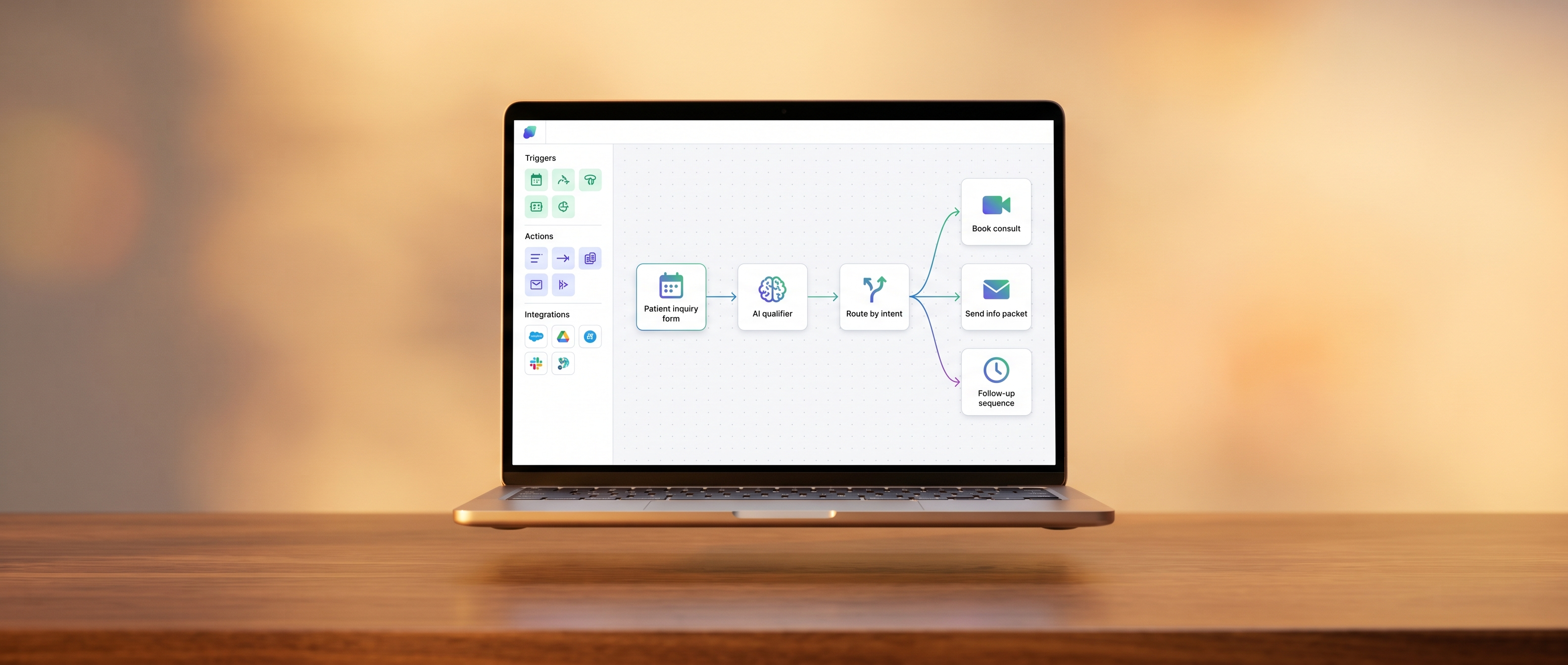
Each automation is small. The compounding is large. A practice that builds twelve months of automation infrastructure with us operates at a fundamentally different scale than a practice that didn't, without adding a single hire or working an extra hour.
Every form, call, and inquiry gets logged, routed to the right team member, and acknowledged within minutes. No lead falls through the cracks. Response time drops from hours to minutes, and conversion goes up because urgency matters in elective medicine.
Consult no-show recovery. Quote follow-up for patients who didn't book. Pre-procedure reminders. Post-procedure care. Long-term re-engagement of patients who lapsed. The sequences your team tries to do manually now run 100 percent of the time.
One asset flows to eight surfaces automatically. Captioning generated, scheduling optimized per platform, analytics aggregated into a single report. Your five to ten phone clips per month become thirty to fifty deployed posts with no one uploading to eight different platforms.
Daily metric collection across every platform. Automated dashboards. Monthly stakeholder reports compiled with narrative summaries. Quarterly competitive benchmarks pulled and formatted. The data assembly is automated. Humans add the strategy.
A real LLM-powered agent (not a chatbot toy) that answers common questions 24/7, qualifies leads, schedules consults, and routes complex questions to humans. HIPAA-compliant with proper guardrails. Meaningfully reduces the front-desk burden.
Larger practices get custom agent development for the workflows that matter most: new-patient onboarding, procedure-specific education, vendor coordination, multi-language patient support, compliance documentation. Real engineering work, built for your specific operations.
Most practices build content and then scramble to figure out where to put it. We flip it: build the infrastructure first, then every asset flows in automatically from day one. Nothing gets wasted. Nothing gets posted late. Everything gets measured.
Month one or two we audit your current operations and identify which workflows produce the biggest return when automated. Usually it's lead intake and review velocity first, the workflows where mistakes cost the most and consistency pays back fastest.
First automations go live in month two or three. Typically lead intake and review velocity to start. Then follow-up sequences, content distribution, and reporting roll out monthly based on what produces the biggest impact for your specific practice.
Quarterly review of which automations are working, which need refinement, which can expand. Monthly reporting on automation-attributable savings: hours saved, leads recovered, revenue captured. The infrastructure compounds and the practice runs better with every quarter that passes.
A short call where we walk through your current intake, follow-up, content, and reporting workflows, and identify which ones are silently costing you patients, hours, or revenue. You'll leave with a clear picture of what the first ninety days of automation infrastructure would change in your practice.