When a patient asks ChatGPT for the best plastic surgeon in your city, ChatGPT names someone. If the answer isn't your practice, the patient may never visit your website at all. AI is the new search engine, and the rules are different. We make sure your practice is the one AI recommends, through technical work most agencies haven't figured out yet. You do medicine. We work the AI layer.
Forty-five percent of shoppers now use AI engines for local business recommendations, up from six percent a year ago. AI Overviews appear in over half of Google searches. The shift is the biggest change in patient discovery since Google launched. The practices that build their AI presence in 2026 and 2027 will compound that position for years. The ones who wait will spend the rest of the decade trying to catch up.
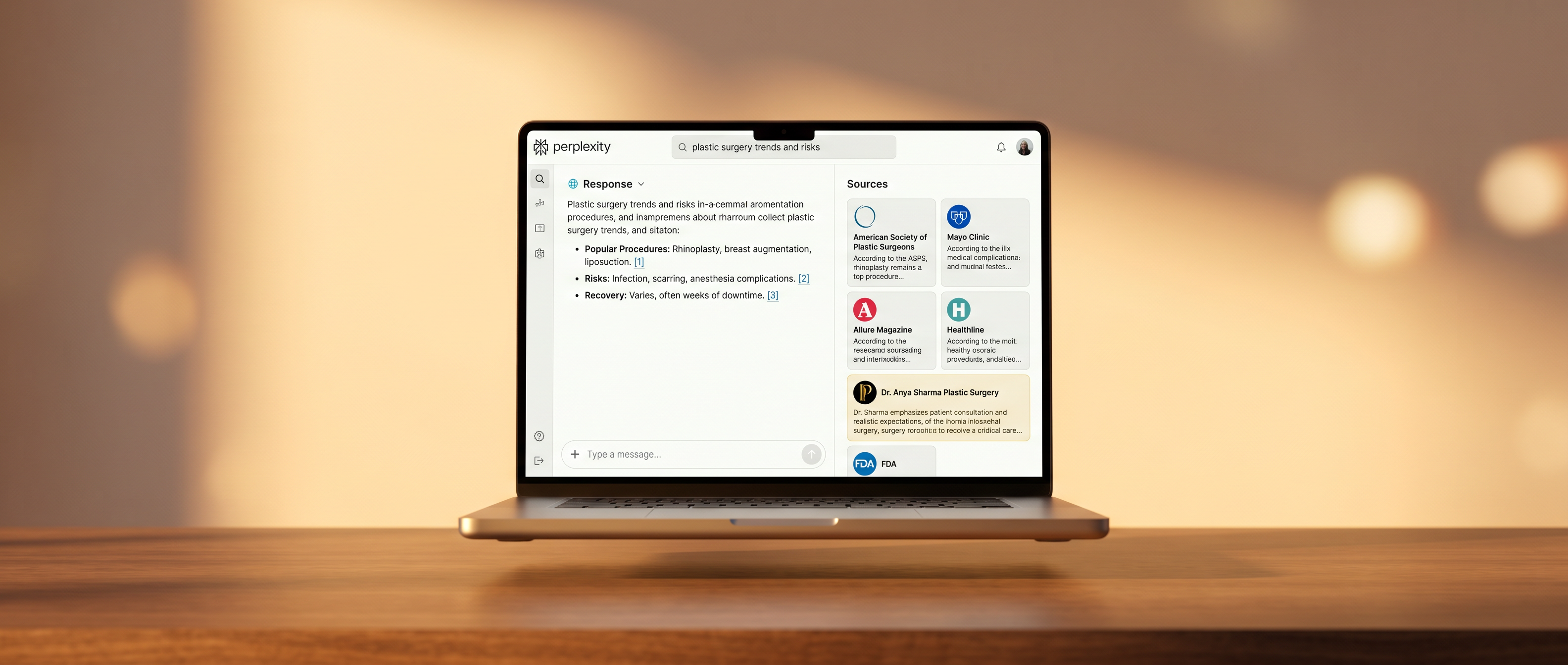
AI engines decide who to cite based on signals most agencies don't know how to send. Structured data, content shaped for AI extraction, entity consistency across the web, authority signals, continuous monitoring across every AI platform: that's the work, and that's what we do.
Most plastic surgery sites are written for 2018 search engines, not 2026 AI engines. We rewrite the content so answers come first, headers nest cleanly, FAQs are explicit: the structure AI engines reward when choosing who to cite.
AI engines cite structured data far more reliably than they parse unstructured text. Physician credentials. Procedure details. FAQs. Reviews. We layer the structured data that makes you easy for AI to attribute and quote.
AI engines build a model of who you are by aggregating signals everywhere they find you. Inconsistency confuses the model. Same name, same address, same bio, same credentials, same photo, everywhere, so the model has high confidence and cites you with high confidence.
AI engines weight sources by backlinks, medical institution citations, press coverage, society leadership, peer publications, vendor partnerships. We build and surface those signals through the directory constellation and the publishing work that makes you the authority AI picks.
Roughly 40 to 60 percent of AI citations change every month. We run a paid tool stack (Profound, Semrush AI, custom prompt tracking) that monitors where you appear in ChatGPT, Perplexity, Google AI Overviews, Gemini, and Claude. Most agencies don't make the investment.
AI citation isn't a project. It's a daily practice. We adjust based on what's working across each platform, where competitors are showing up that you should be, and what new patterns are emerging as the engines refine their source weighting.
The earlier you start, the more the position compounds. We baseline where you stand today across every AI engine, do the structural work, then monitor and adjust monthly as the AI search landscape keeps shifting.
Month one is a baseline audit. We run a standardized set of queries across ChatGPT, Perplexity, Google AI Overviews, Gemini, and Claude, and show you exactly where your practice appears, where competitors appear instead, and what gaps to close first.
Months one through three are the structural build. Structured data deployment. Content restructured for AI extraction. Entity consistency sweep across the web. The technical foundation that makes you eligible to be cited.
From month three on you get monthly citation reports showing visibility across every AI platform and query. Quarterly competitive benchmarks. Continuous adjustment based on what's moving. The position compounds in the background while most competitors are still figuring out what AI search means.
We'll run your practice against the top queries patients are asking ChatGPT, Perplexity, and Google AI in your market, and show you who's getting cited and who isn't. Most doctors are shocked by what they see. The earlier you start the work, the bigger the compounding advantage.